



















How to solve problems when everything seems to be going wrong on a shoot
May 22, 2024
Alex Baker
Alex Baker is a portrait and lifestyle driven photographer based in Valencia, Spain. She works on a range of projects from commercial to fine art and has had work featured in publications such as The Daily Mail, Conde Nast Traveller and El Mundo, and has exhibited work across Europe
Share:
You know what they say about the best-laid plans of mice and men, and it also applies to photography. You can plan a shoot all you want, but I can almost guarantee that there will still be room for something to go awry. So, what do you do in this case? Well, you become a problem solver and improvise.
In this video, photographer Nathan Elson shows us a shoot he’d planned to do in a bright warehouse studio. He’d planned to have hard sunlight streaming through the windows. Unfortunately, the day of the shoot had the grimmest weather, with storm clouds and rain and no sunshine in sight.
Luckily, Nathan was able to pivot to using artificial lighting. If you’re predominantly a natural light shooter (and I am much of the time because honestly I light it and it suits many of my more mature clients), then always always bring some sort of artificial lighting just in case.
If it stays in your bag and you don’t need it, great! But there have been several occasions where I’ve needed just an extra pop of light, a highlight or rim light, or a completely different look altogether.
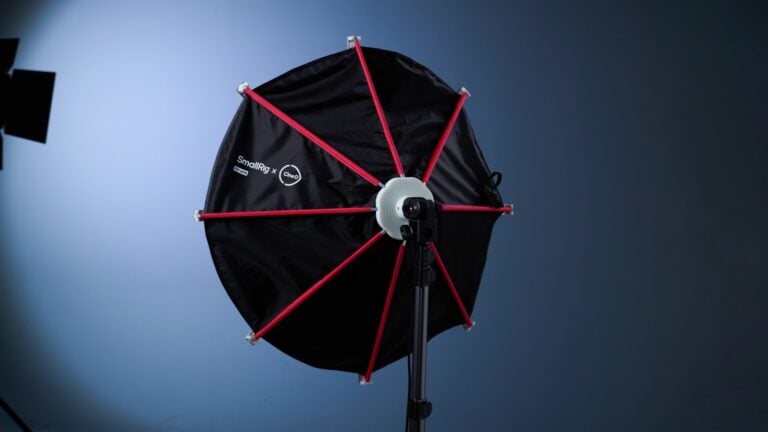
To get around the dark grey day, Nathan used an Aputure 600D light with a 26-degree spotlight mount and a colour temperature orange (CTO) gel to simulate warm sunlight. He used the built in flags to direct the hard light onto the model. Another Aputure 600D with a Light Dome 150 was used as a fill light to reduce contrast and add catch lights in the model’s eyes.
For the third look, Nathan switched the lights around and used the large modifier as the key light, and added a gobo to the spot light, creating some interesting shadows to break up the flatness a little.
Honestly, I think everyone should be able to shoot with both natural (available) or artificial light and make it work just as well with either. Light is light, as they say. I could also argue that shooting with artificial light gives you more flexibility in where to set up; you can move around more and move the lights to suit, and your settings are much more consistent. You won’t suddenly have an underexposed image when a cloud rolls past the window!
What do you prefer to shoot? Natural or artificial light?
See more from DIYPhotography.net on Google
Add DIYPhotography.net as a trusted source. This makes
our stories more likely to appear in your Google Search results.
 Add as a preferred source on Google
Alex Baker
Alex Baker is a portrait and lifestyle driven photographer based in Valencia, Spain. She works on a range of projects from commercial to fine art and has had work featured in publications such as The Daily Mail, Conde Nast Traveller and El Mundo, and has exhibited work across Europe



Join the Discussion
DIYP Comment Policy
Be nice, be on-topic, no personal information or flames.
2 responses to “How to solve problems when everything seems to be going wrong on a shoot”
Natural light, not that I prefer it but I hate carrying extra weight.
Joe Edelman said that natural light is harder because you are not in full control of it. Artificial light, on the other hand, gives you total control.