













Lightpainting Lightsabers
Mar 30, 2009
Udi Tirosh
Udi Tirosh is an entrepreneur, photography inventor, journalist, educator, and writer based in Israel. With over 25 years of experience in the photo-video industry, Udi has built and sold several photography-related brands. Udi has a double degree in mass media communications and computer science.
Share:
 When I was a kid, there was nothing I liked more the swords. And space. This is why I was so exited when the Return of the Jedi came out. WOW a sword that you battle with on a spaceship – I was instantly hooked. This was the first Starwars film I saw and I watched all the series in no time. (Mind you, this was before DVD rental era, so Daddy had to kindly drive me around various theaters around the country).
Now I am a grown up, and love grown up films where you get two people in a room and let them talk about love, death and marriage for ninety minutes. NOT! I’d still choose a robots-fighting-in-space-with-swords movie over any film featuring Kathy Bates. Unless, of course, Bates is playing a giant robot smacking some other robot in space with a sword.
So how does this all connect to photography? As you may have noticed, one of my photography loves is Light Painting. This is why I was so thrilled when Ben Matthews created a Lightsabers for his light painting works. Just before you read on, check out Ben’s great light painting gallery. See what great art he does with them Sabers. Read on to discover the magic that Ben created, and to get detailed instructions on creating your own Lightpainting Lightsabers:
Ben’s Story:

I have been taking pictures for about ten years now, and I have enjoyed developing a range of skills and techniques in that time. DIY photography has always interested me, but not in the most common forms – I never did the pinhole camera thing. Biscuit tins and foil never held much sway with me. I have however always enjoyed playing with lighting techniques – whether it’s raiding Ikea for dirt cheap lamps, bulbs and mirrors to construct studio effects, or building lighting toys. I made a ring light out of fairy lights, which gave beautiful results, but either the bulbs got too hot and burned the ring, or they were so soft they failed to light anything.
My latest enthusiasm in photography has been nightwork and lightpainting. A lot of my work is done with a simple pen torch, a flashlight and string, but I wanted to create a broad stroke of colour, a paintbrush rather than a pen effect. Having seen some inspiring ideas online, I decided to try putting one together. The best I had seen had involved paint rollers, but I couldn’t work out how I would use them, so I decided on a simple “light on a stick” design.

The easy part is choosing the light. Your local car parts store (Halfords, in the UK) will stock a million different types of interior/exterior lighting accessories for cars – neon tubes, LED arrays, short sticks, long wires. While you might not want to “pimp my ride” necessarily, the 12v power supply is ideal. Eight AA batteries will power it beautifully, once supplied with a little ingenuity and electrical engineering (seriously, much easier than it sounds). I soldered my work, but twisting the wires and wrapping them with insulation tape would work just as well. Be warned though, selecting many different colours and styles will be good for you, but confusing for the shop workers. Expect questions as to why you’d be putting both red and green on the same car, for example…
Once you have chosen your light, find a carrier – I chose a simple piece of 2”x1” untreated pine, sanding the corners off to make it more comfortable. I used neon light tubes (in blue and red), although the following technique would work for any light source. Attach the light to the carrier (screws will always work better than glue), and cut off the 12v car lighter adapter, leaving yourself enough wire to work with. Separate the two conjoined wires, and strip the ends, leaving bare metal.
Eight AA (1.5v) batteries will power the light source. You can use ten 1.2v rechargeable batteries, theoretically, but I haven’t tried that. You will need an eight-battery holder, or two four-battery holders, as I used (for ergonomics more than anything – they stuck to the lines of the stick better.) If you’re using two, make sure you connect them in series. Connect the positive of one to the positive negative of the other, and vice versa, leaving two free ends. This is your power supply.
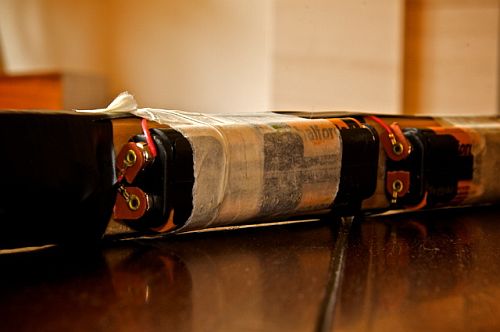
I used a “press to make” switch in my design, although a switch is not essential, and a simple on-off slider will work just as well. Simply place this in one side of the circuit between the batteries and the light. Now for the final check. Connect one end of the battery wire to the light, and then the other, via the switch, if one is being used. Slide the switch, push the button, or indeed, just hope. If it does not work, do not panic. All of the lights are polarity sensitive, so you may need to switch the wires around to get a result. Rejoice when you see the light! Once it’s working, solder the connections, or securely twist them, and seal with insulating tape (or heat shrink, if you have any.)
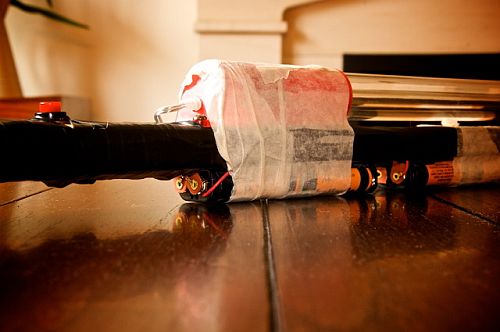
I finished my lights off with copious amounts of duct and insulating tape to make them more stable – holding the batteries onto the carriers, strapping down wires, and making a handle. On my first wand, I wrapped a small piece of cloth around the handle, and strapped it down with tape, but I have to say it hasn’t made that much difference.
Now enjoy them! A few words of advice – the lights look best at a medium aperture (roughly f10), as they can appear blocky otherwise. Keep them moving while in shot. Finally, be reasonably gentle with them, especially the neon tubes – they can break. But otherwise, go forth and play!


Udi Tirosh
Udi Tirosh is an entrepreneur, photography inventor, journalist, educator, and writer based in Israel. With over 25 years of experience in the photo-video industry, Udi has built and sold several photography-related brands. Udi has a double degree in mass media communications and computer science.


Join the Discussion
DIYP Comment Policy
Be nice, be on-topic, no personal information or flames.