

















Devastating image of dead birds wins Bird Photographer of the Year 2024
Sep 24, 2024
Alex Baker
Alex Baker is a portrait and lifestyle driven photographer based in Valencia, Spain. She works on a range of projects from commercial to fine art and has had work featured in publications such as The Daily Mail, Conde Nast Traveller and El Mundo, and has exhibited work across Europe
Share:
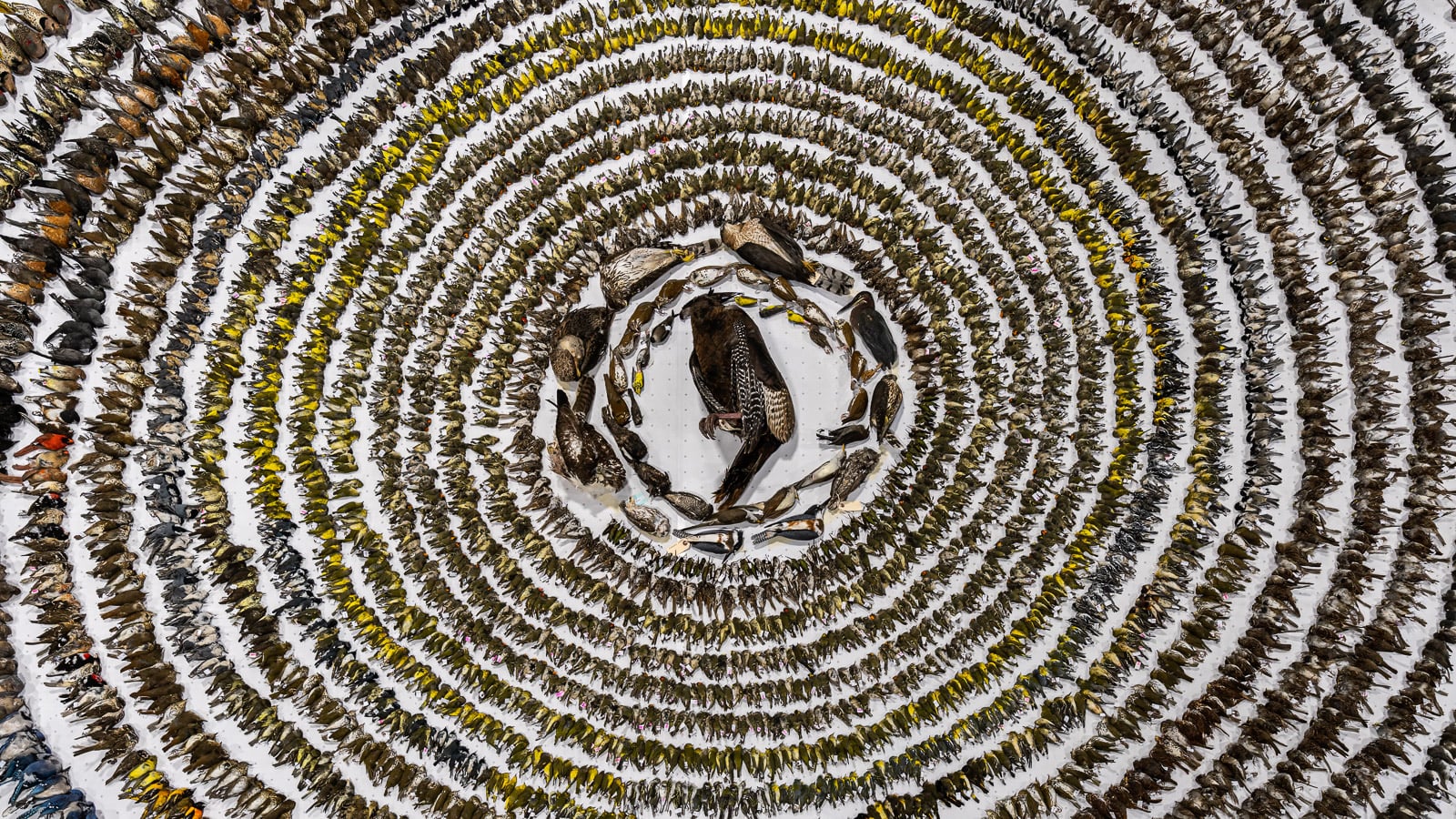
The Bird Photographer of the Year 2024 awards have highlighted the impact of urbanization on bird populations. This year’s top prize went to Canadian conservation photojournalist Patricia Homonylo for her haunting image titled When Worlds Collide. The photograph features a poignant display of over 4,000 birds that tragically died after colliding with windows in Toronto. Homonylo’s powerful image highlights the consequences of human activity on wildlife, taking home the grand prize in the world’s largest bird photography competition.
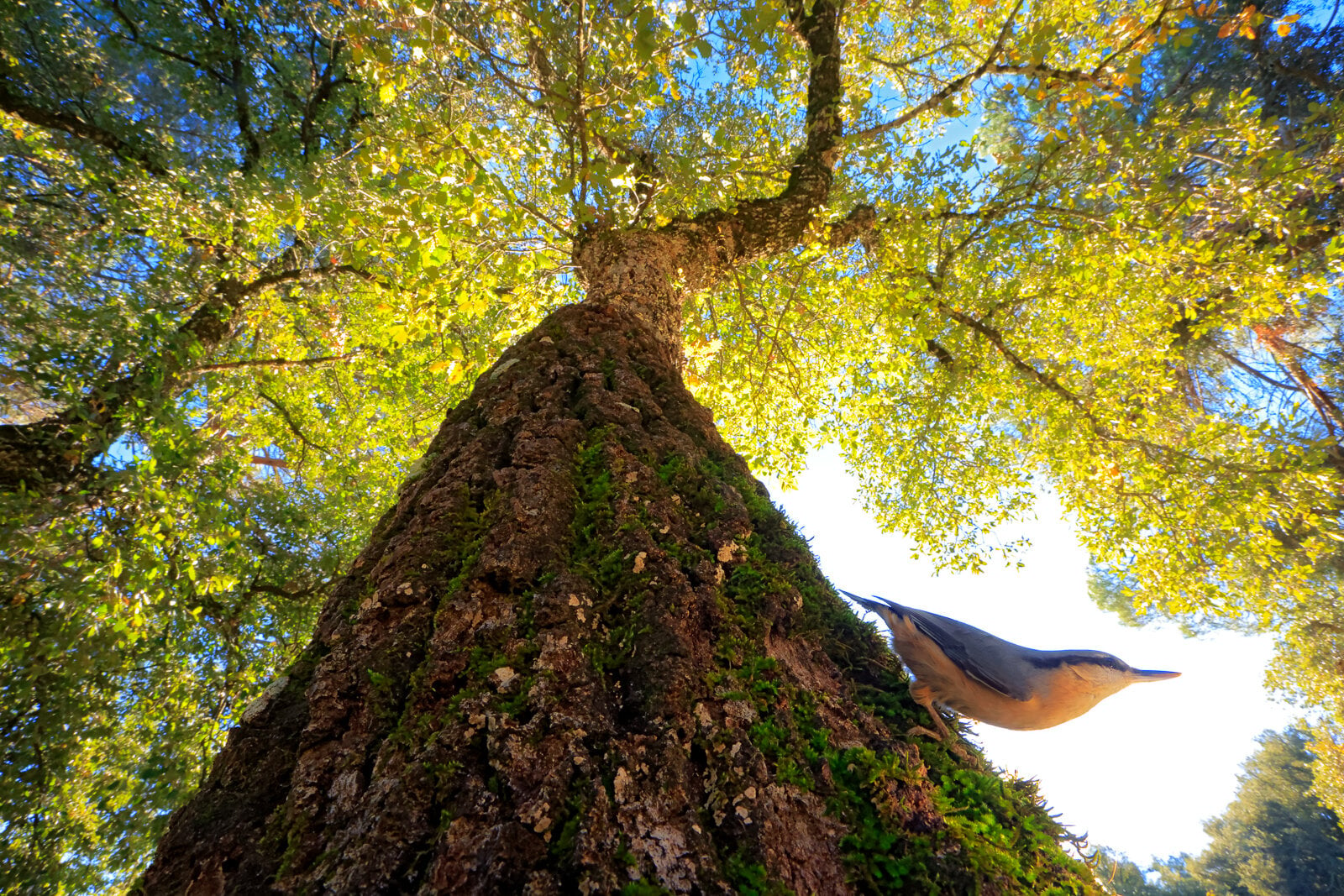
In addition to Homonylo’s achievement, the competition also celebrated the creativity of younger photographers. The Young Bird Photographer of the Year 2024 title was awarded to 14-year-old Spanish photographer Andrés Luis Domínguez Blanco for his artistic image of a nuthatch descending an oak tree.
The competition’s eight adult categories, which ranged from Best Portrait to Comedy Bird Photo, also showcased the diverse beauty of avian life and the talent of photographers from all over the world. Here are the rest of the winning entries:
Overall Winner Bird Photographer of the Year 2024
OVERALL WINNER AND GOLD AWARD WINNER BIRD CONSERVATION (SINGLE IMAGE) – Patricia Seaton Homonylo, Canada
WHEN WORLDS COLLIDE – Migratory birds, various. Toronto, Ontario, Canada.

Each year during spring and fall migration over 1.3 billion birds die in North America as a result of window collisions. A network of dedicated volunteers heads out each morning to pick up the pieces. For over 30 years FLAP (Fatal Light Awareness Program) volunteers have patrolled cities worldwide in search of birds that have collided with windows. While their efforts have saved an impressive number of bird collision survivors, the majority do not survive the impact. But the fallen birds are never left behind. Their bodies are collected and their lives honoured in the annual ‘Bird Layout’. The Layout brings volunteers together to arrange the dead birds in an emotive and provocative display. While The Layout honours the fallen birds and brings closure for the volunteers, it is also a critical event that raises public awareness and highlights a global issue. I have volunteered with FLAP for four years and attend The Layout annually. From hawks to hummingbirds, this 2022 display includes more than 4,000 birds. Sony A7R IV with Sony 16–35mm f/2.8 lens. 16mm; 1/160s; f/4; ISO 500.
Bird behaviour
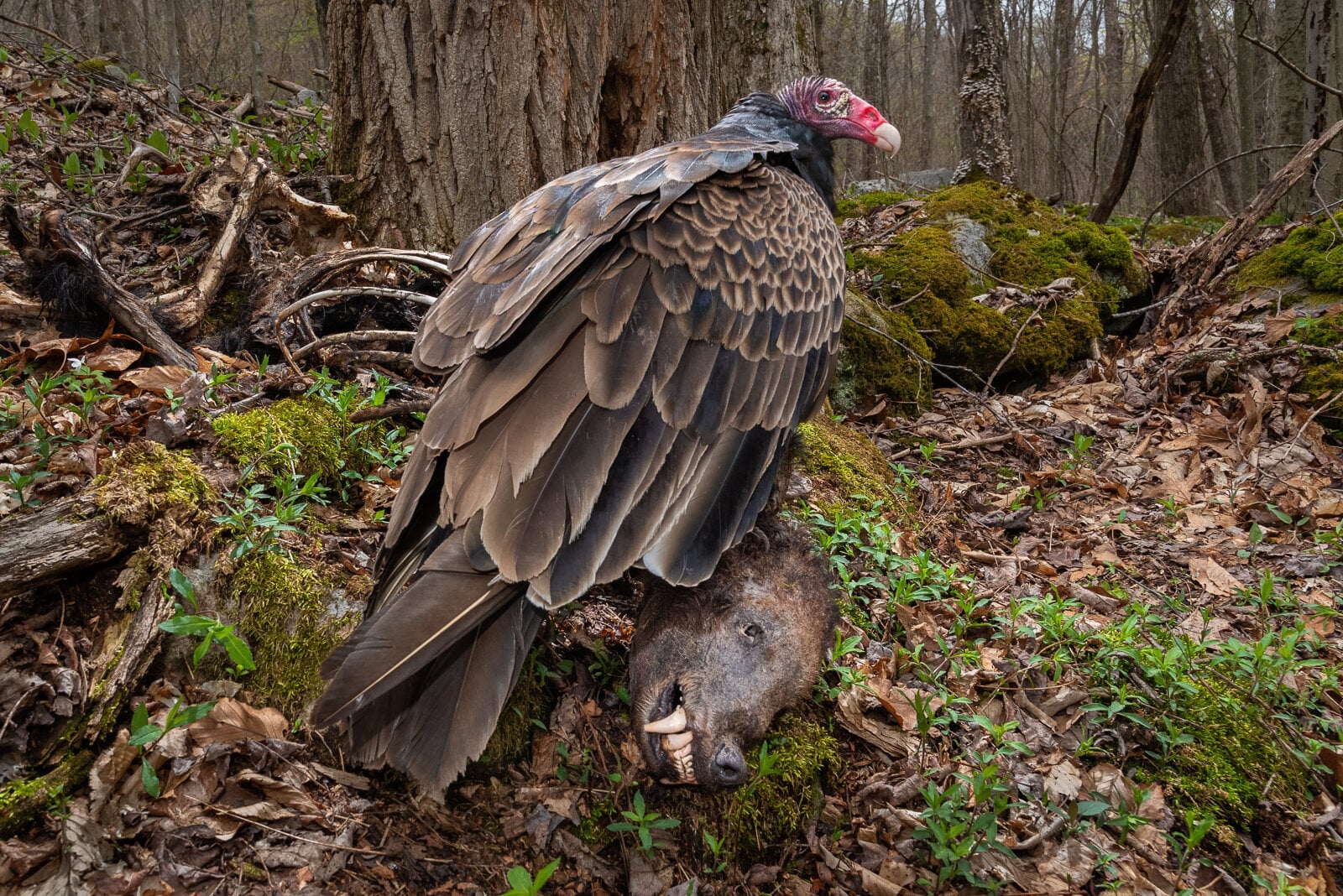
GOLD AWARD WINNER – Nathaniel Peck, United States
SCAVENGER – Turkey Vulture, Cathartesaura. West Virginia, United States
Best Portrait
GOLD AWARD WINNER – Alan Murphy, United States
WINTER PINK – Grey-crowned Rosy-finch, Leucostictetephrocotis. Homer, Alaska, United States
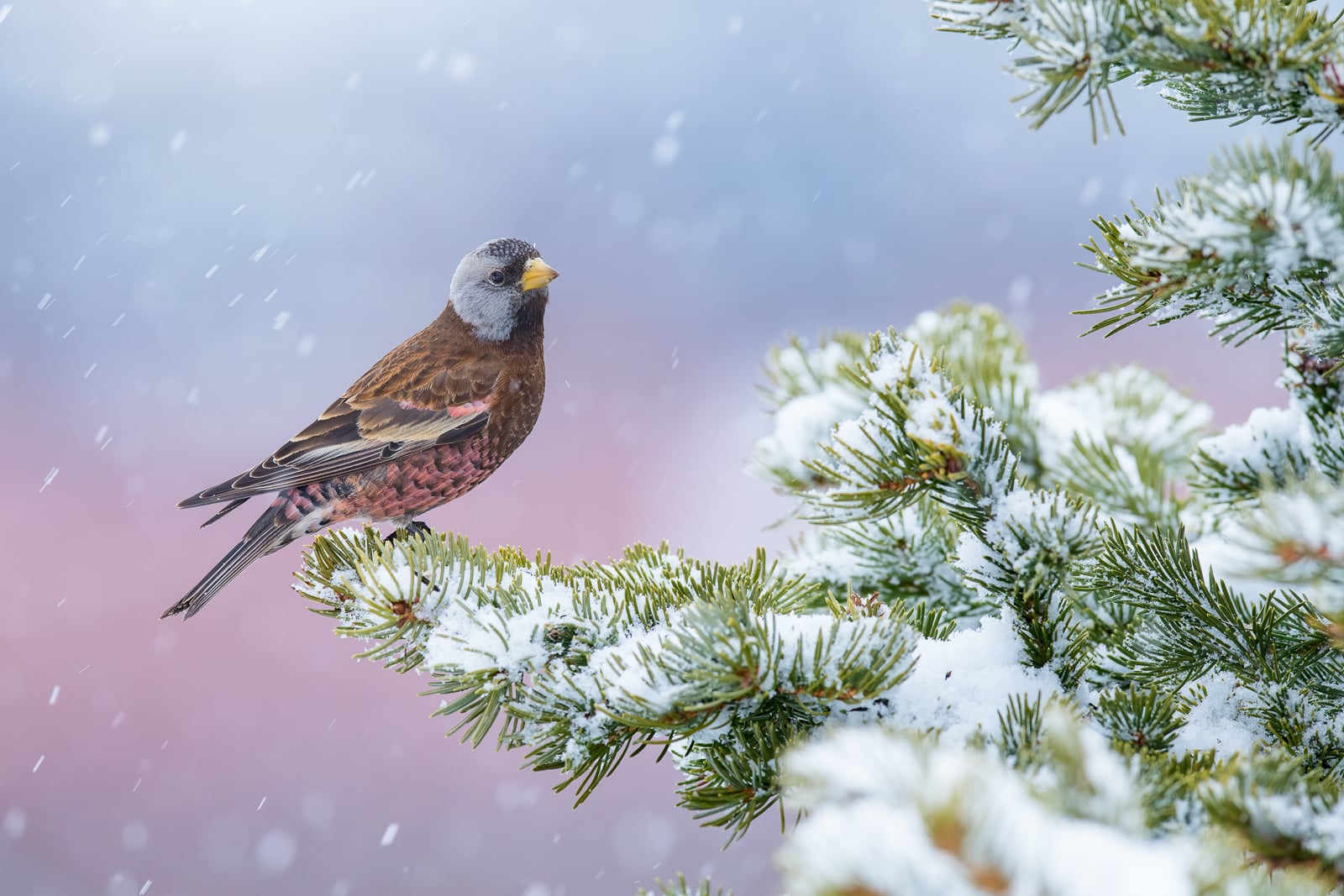
During my stay in Alaska, Grey-crowned Rosy-finches would gather in large flocks next to my hotel. Fortunately for photographers, they are a very tame species and they allowed me to set up my tripod and camera to grab a few frames before they all took off. The colours in the background are distant boats in a marina. Nikon D850 with Nikon 600mm f/4 lens. 600mm; 1/250s; f/6.3; ISO 1,000.
Birds in flight
GOLD AWARD WINNER – Hermis Haridas, India
DAWN’S WHISPERS: GRACEFUL HOOPOE SILHOUETTE AT SUNRISE – Eurasian Hoopoe, Upupa epops. Al Qudra Lakes, Dubai, United Arab Emirates
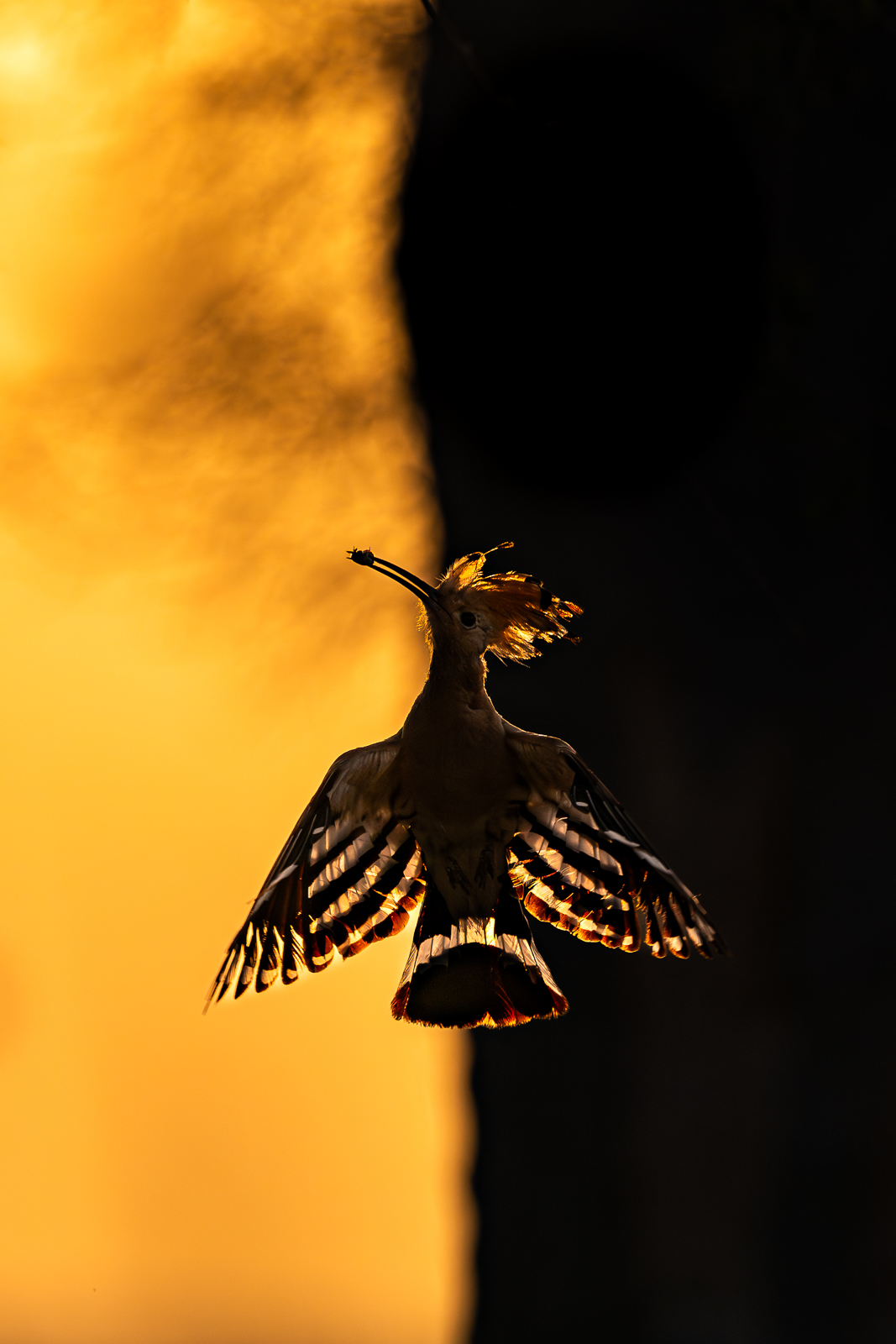
A Eurasian Hoopoe took flight with its wings spread in a smooth motion across the canvas of the early-morning sky illuminated by the sunrise’s bright hues. I saw that this bird would occasionally grab its prey in the air and other times on the ground. Additionally, I noticed that each time it caught prey, it flew in the same direction to a nearby tree. That was when I had the idea to photograph the bird against a background divided into dark and light, representing the contrasting sides of existence. The following morning, I returned to the same spot well before sunrise, eager to witness nature’s spectacle unfold once again. Anticipation heightened as the first rays of light bathed the landscape, and, true to my expectations, the hoopoe appeared in the distance, gliding gracefully towards the perch that was familiar from the previous day. With my camera poised and settings adjusted, I commenced capturing the unfolding scene. Among the flurry of clicks, I chanced upon a frame that resonated deeply with me – a moment frozen in time, brimming with unique charm. It was as if nature had bestowed upon me a gift, a singular composition that encapsulates the essence of the hoopoe’s beauty and grace. Indeed, many have remarked that this frame is a marvel that cannot be replicated – a testament to the serendipitous wonders that await those who seek them amid the natural world. Nikon Z8 with Nikon 400mm f/2.8 lens. 400mm; 1/3,200s; f/6.3; ISO 320.
Birds in the environment
GOLD AWARD WINNER – Kat Zhou, United States
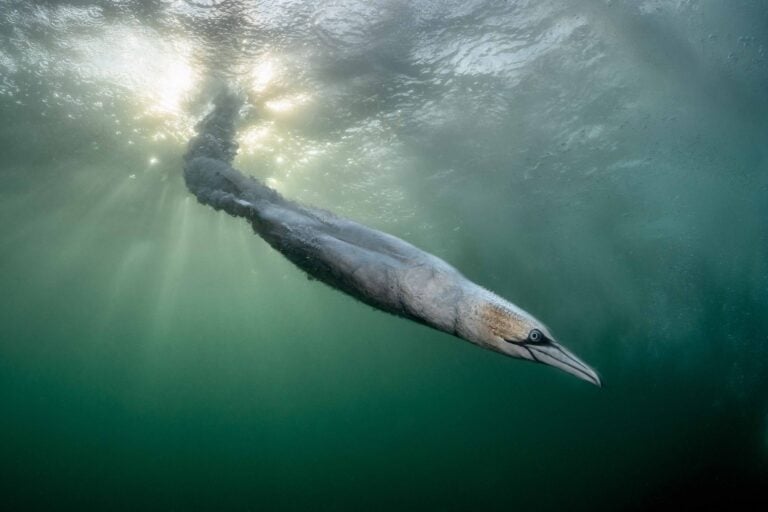
IMMERSION – Northern Gannet, Morus bassanus. Shetland, United Kingdom.
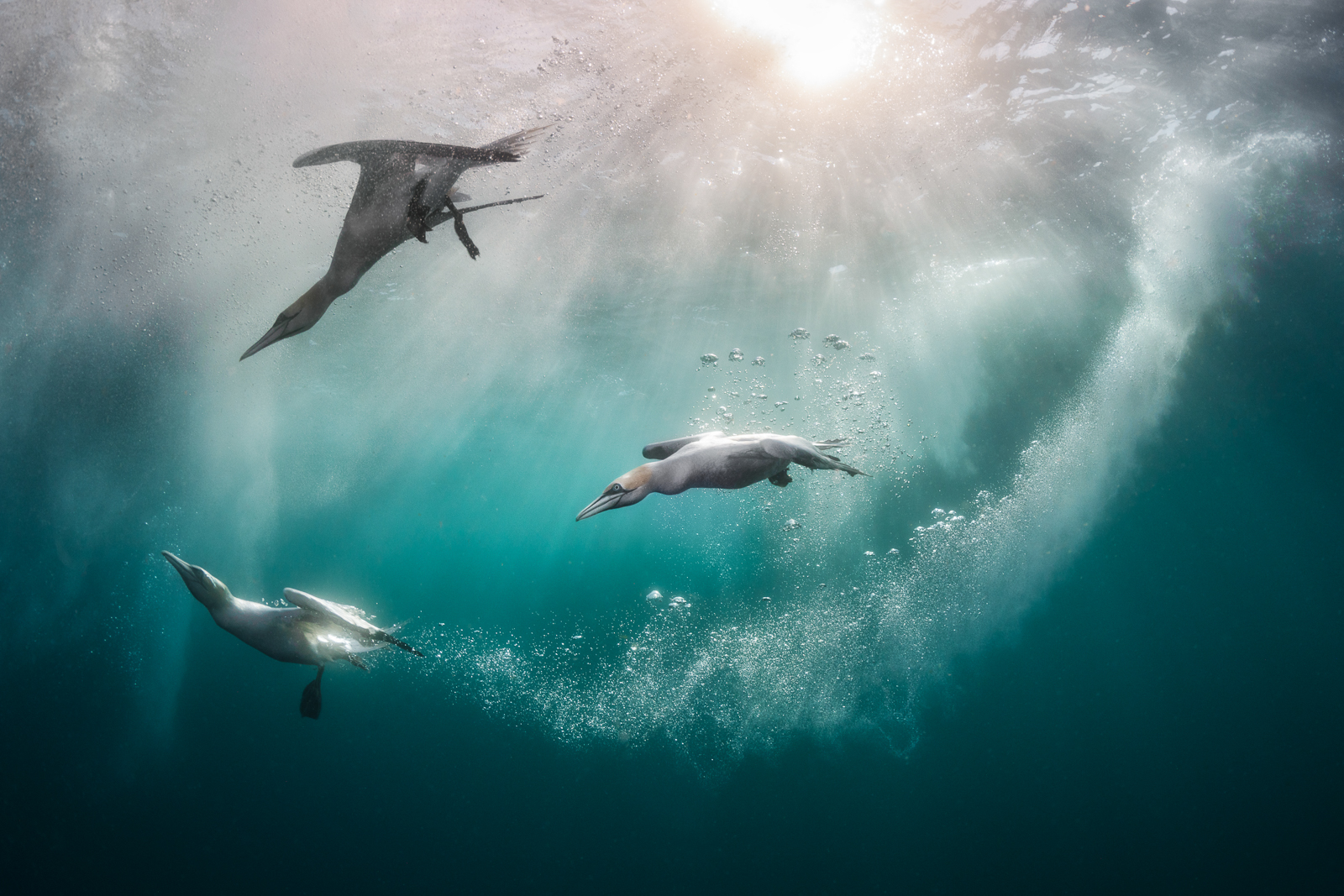
Here we see a trio of Northern Gannets diving into the ocean on a sunny day in Shetland. The species is Scotland’s largest seabird, and they are remarkably adept in the water, with the ability to dive to depths as far as 22 metres. I took this photo while scuba diving from a boat near Noss, which is home to the UK’s seventh largest colony of Northern Gannets. In the past the population has been estimated at around 25,000 birds, though their numbers were unfortunately severely reduced by the avian flu outbreak. It is unclear when, or if, their population will be able to recover. Dead herring from a local herring fishery were used to attract the birds to the boat. Nikon D850 with Nikon 8–15mm Fisheye lens. 15mm; 1/250s; f/14; ISO 100.
Black and white
GOLD AWARD WINNER – David Stowe, Australia.
HIPPO IMPRESSION – Hoary-headed Grebe, Poliocephalus poliocephalus. Sydney, Australia.
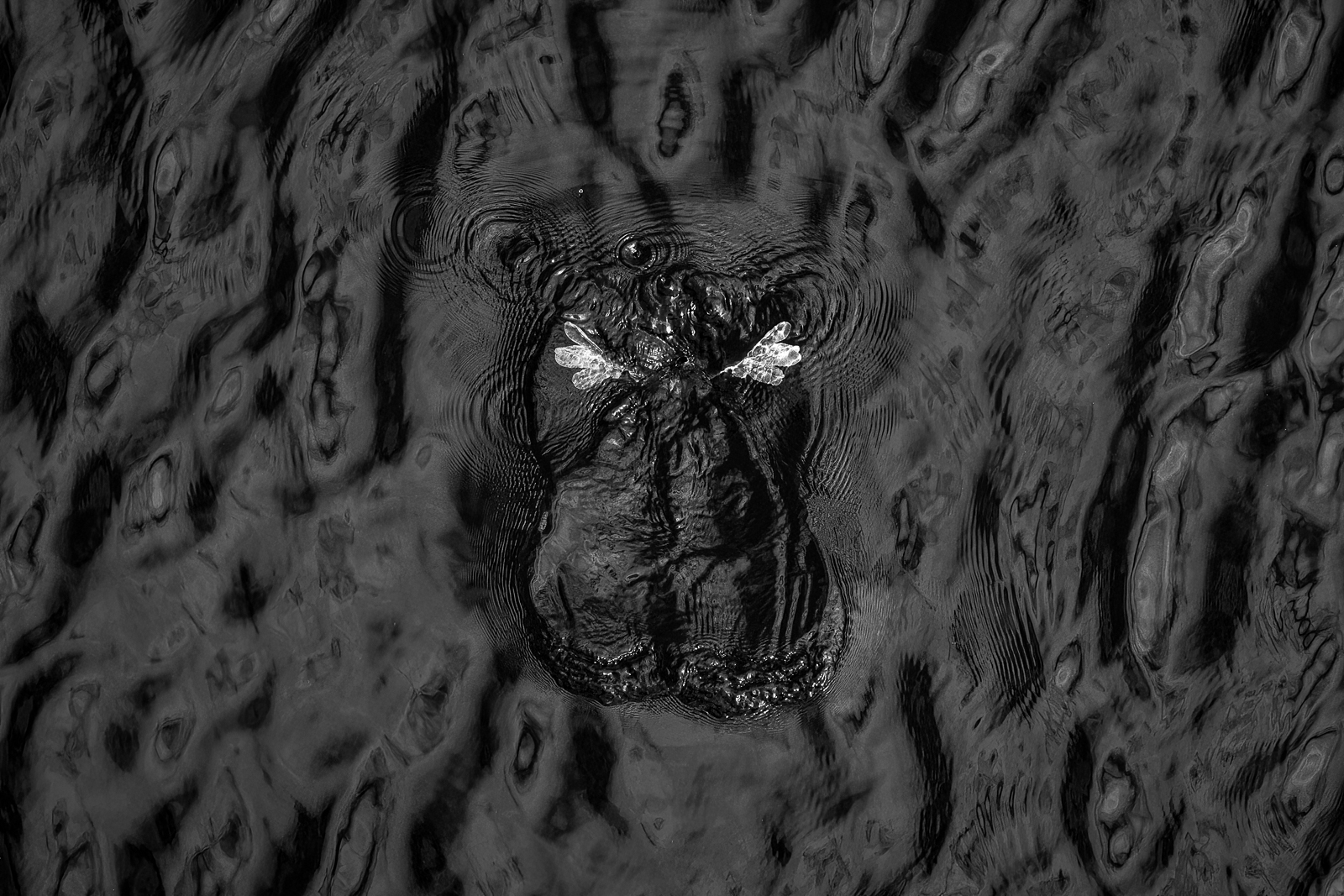
This photograph shows a Hoary-headed Grebe as it disappears below the surface of the water to feed, pushing into the depths with its huge paddle-like feet. I took the image from a raised platform high above the wetland. With a little bit of imagination, the combination of bird and ripples look like the head of a hippo. Canon EOS R5 with Canon RF 100–500mm f/4.5–7.1 lens. 500mm; 1/2,500s; f/8; ISO 1,600.
Comedy Bird Photo
GOLD AWARD WINNER – Nadia Haq, United States
A MODERN DANCER – Adélie Penguin, Pygoscelis adeliae. Antarctica.
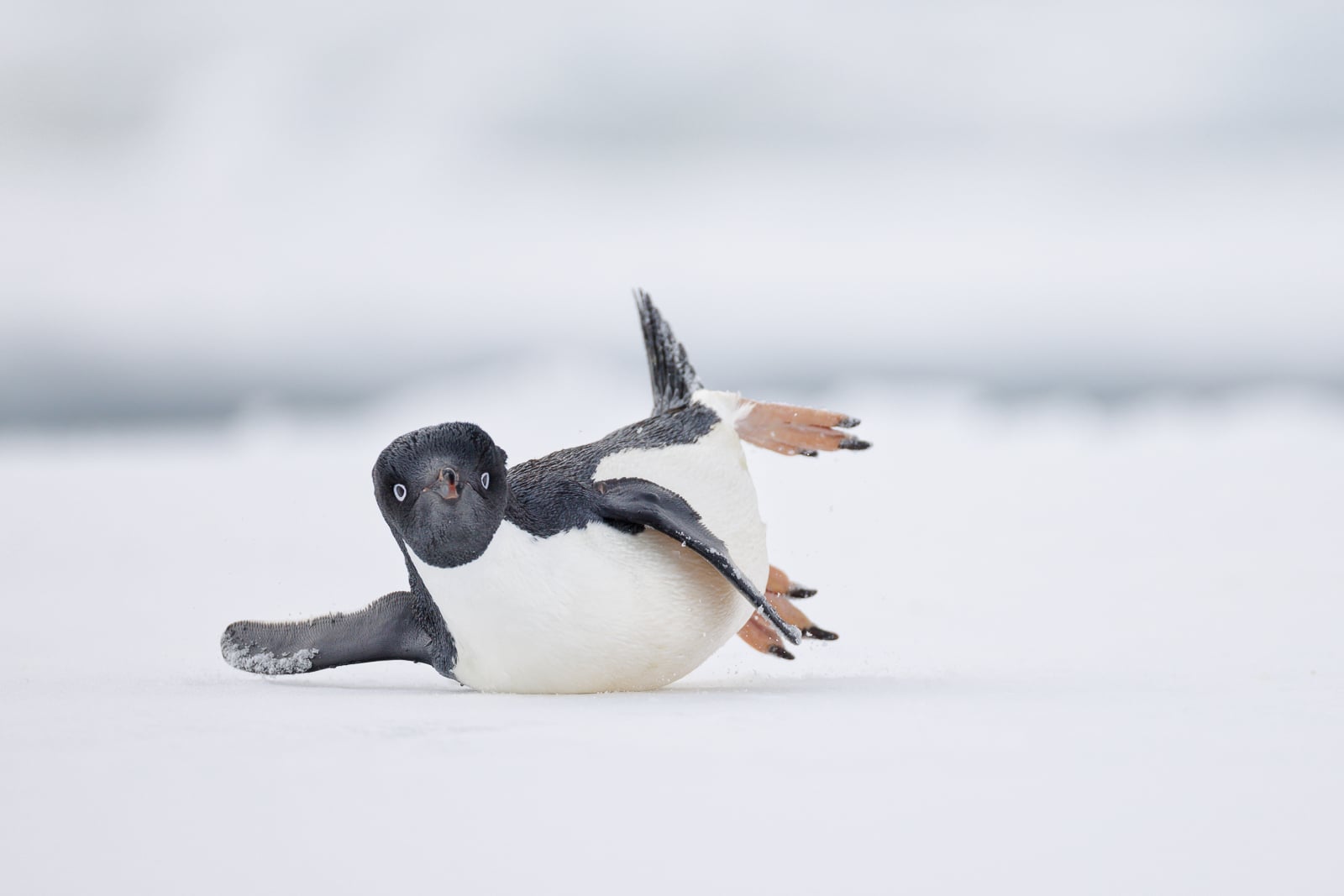
I was sitting on a Zodiac next to my husband and 10-year-old son near Brown Bluff, Antarctica, when we spotted a group of Adélie Penguins on some sea ice. As we slowly approached them, they started to toboggan on the ice, and I captured one of them sliding as if performing a modern dance move. Canon EOS R5 with Canon RF 600mm f/4 lens. 600mm; 1/4,000s; f/4; ISO 160.
Urban birds
GOLD AWARD WINNER – Grzegorz Długosz, Poland
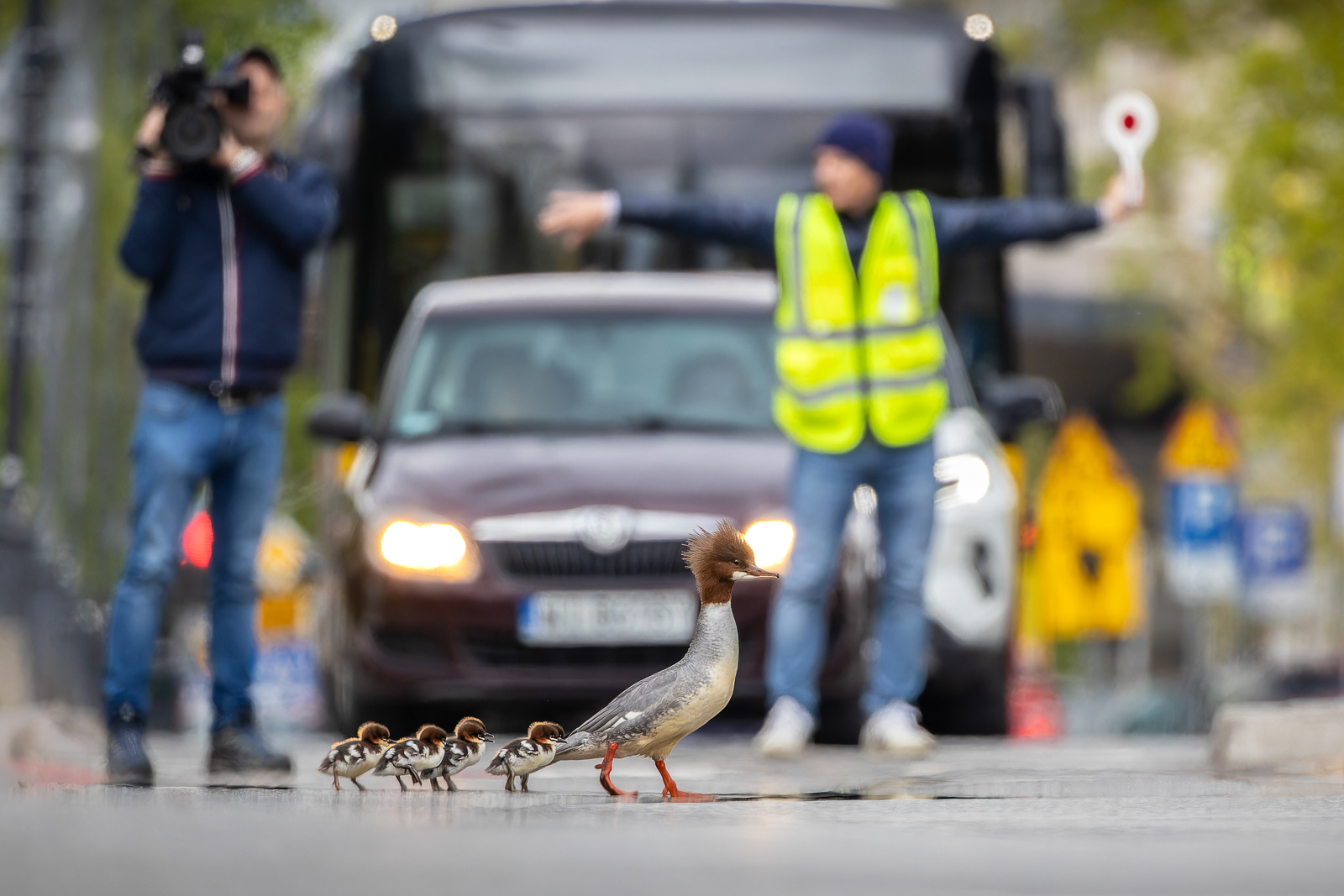
TREACHEROUS JOURNEY – Goosander, Mergus merganser. Warsaw, Poland.
Young Bird Photographer of the Year 2024
And GOLD AWARD WINNER 12-14 Years – Andrés Luis Domínguez Blanco, Spain
PERSPECTIVE – Eurasian Nuthatch, Sitta europaea. Grazalema, Southern Spain, Spain
15-17 Years
GOLD AWARD WINNER – Emil Wagner, Germany.
HUMAN AND NATURE (AND DOG) Grey Plover, Pluvialis squatarola. Mecklenburg-Western Pomerania, Germany.
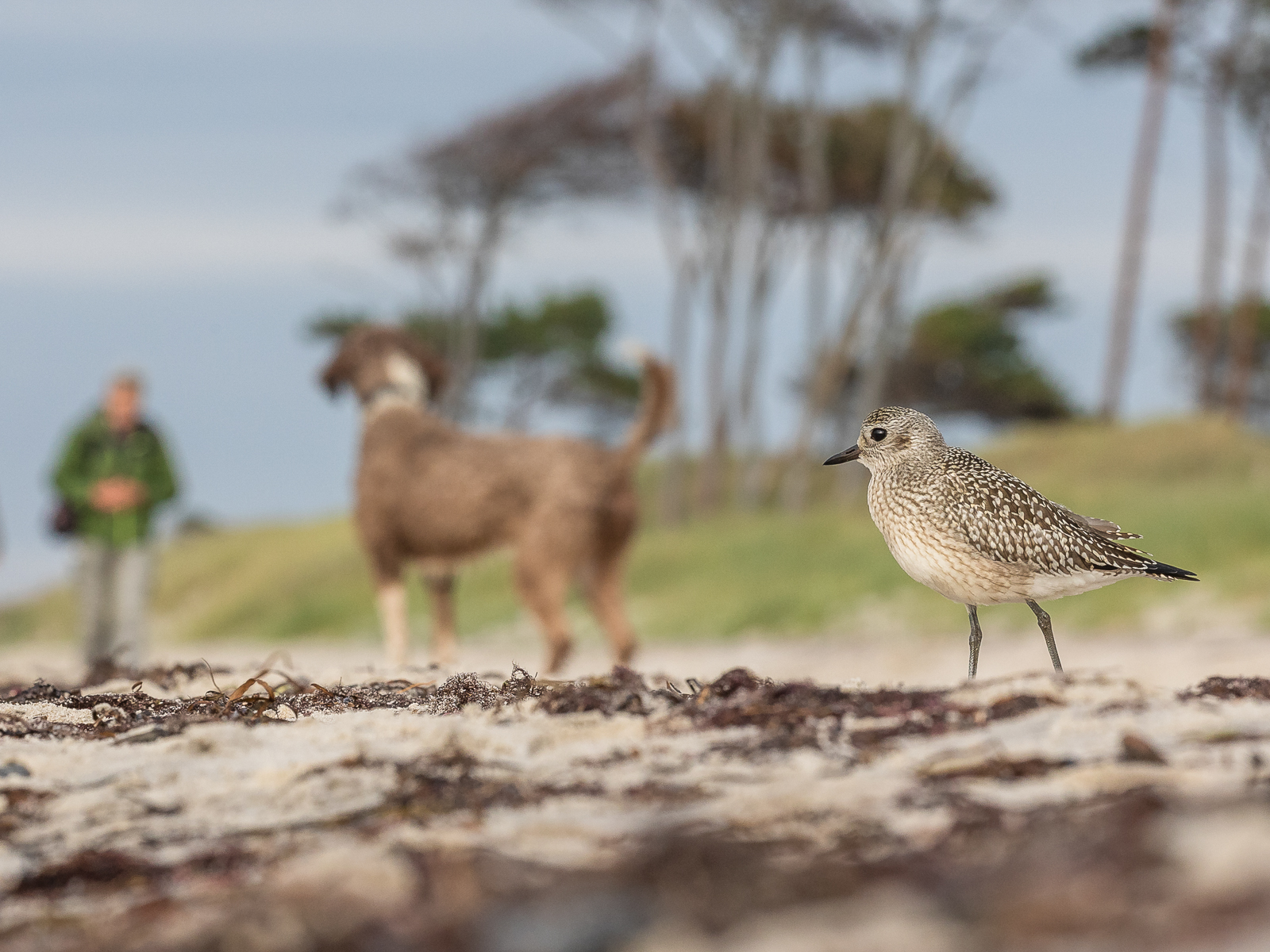
I took this photo on a beautiful beach on the Baltic Sea. There are a number of waders and other birds here, but also many visitors who enjoy the beautiful landscape. In this case there was also a dog who initially did not notice the Grey Plover. The Grey Plover, however, did notice the dog and flew away shortly after I took the photo. While I do not believe this incident greatly stressed the bird, it is crucial to acknowledge the potential impact of human activity and tourism on protected species and their habitats. In my opinion, the scene represents this potential conflict between humans and nature. Canon EOS R6 with Canon 100–400mm f/4.5–5.6 II lens. 248mm; 1/640s; f/14; ISO 1,600.
11 and under
GOLD AWARD WINNER – Julian Mendla, Germany
TURBULENT FISH HUNT – Eurasian Bittern, Botaurus stellaris. Lake Federsee, Bad Buchau, Germany
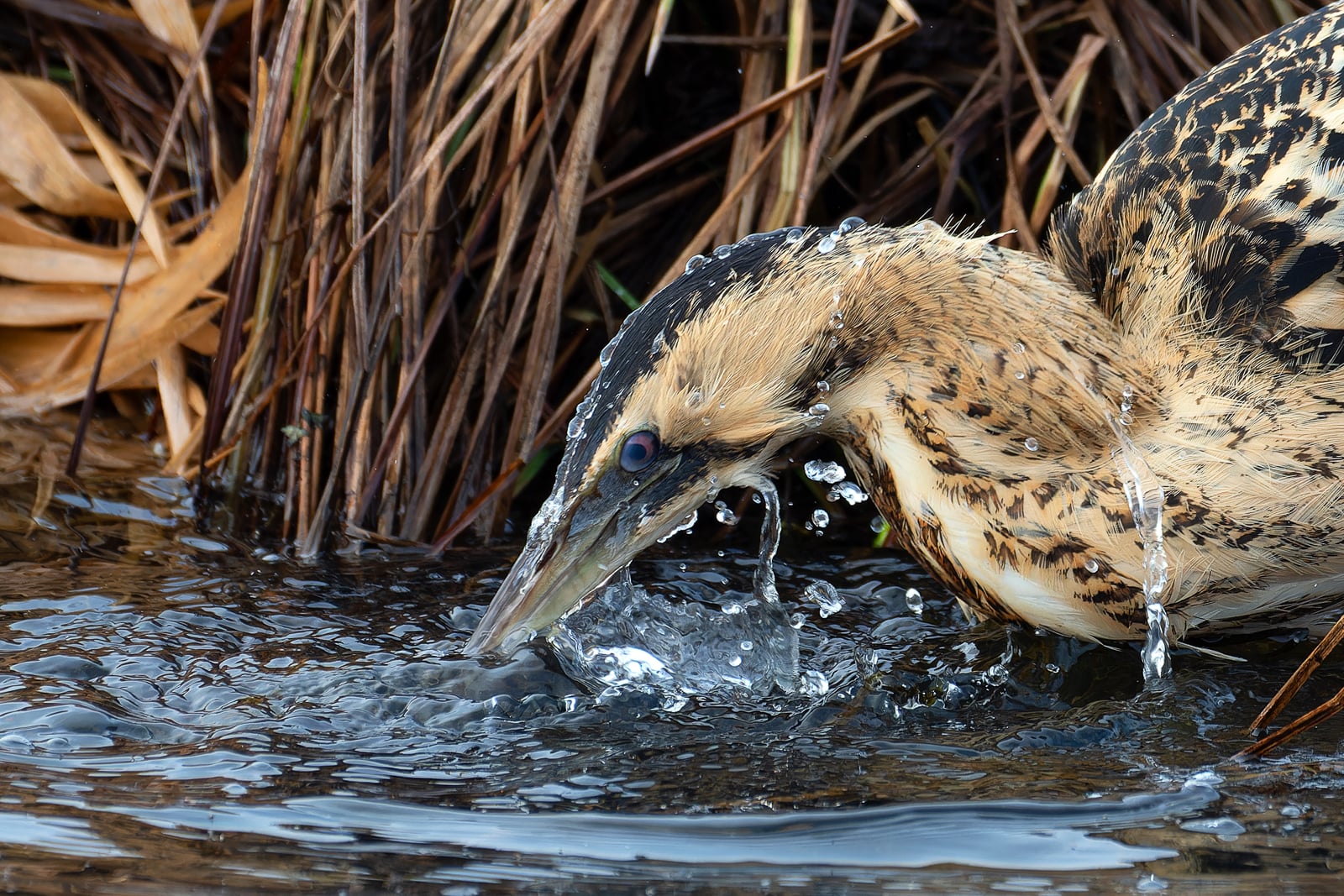
Lake Federsee is a famous wintering area for numerous migratory birds. From November to March, Eurasian Bitterns are frequent visitors to this lake. As soon as the lake freezes over, these rare birds retreat to trenches through the reeds. Surprisingly, this individual was very close to the boardwalk that leads through the nature reserve. From there, I could easily watch its fishing campaign and take numerous photos. Nikon D500 with Nikon 200–500mm f/5.6 lens. 500mm; 1/800s; f/5.6; ISO 1,000.
The competition’s winners and highly commended entries are featured in a coffee-table book published by Princeton University Press, and all the winning images and runners-up can be seen on the competition website.
See more from DIYPhotography.net on Google
Add DIYPhotography.net as a trusted source. This makes
our stories more likely to appear in your Google Search results.
 Add as a preferred source on Google
Alex Baker
Alex Baker is a portrait and lifestyle driven photographer based in Valencia, Spain. She works on a range of projects from commercial to fine art and has had work featured in publications such as The Daily Mail, Conde Nast Traveller and El Mundo, and has exhibited work across Europe
Related Posts
 2020 Bird Photographer of the Year winning image turns birds into impressionistic art
 Visit the secret life of birds with 2021 Bird Photographer of the Year finalists
 Dramatic image of falcon attacking pelican wins Bird Photographer of the Year
 A roadrunner stopped by USA-Mexico border wall wins 2021 Bird Photographer of the Year
Join the Discussion
DIYP Comment Policy
Be nice, be on-topic, no personal information or flames.